Showing posts with label 1950s. Show all posts

Friday, May 22, 2020

1959 Powered Railcar with Dome

Powered Railcar Has Dome for Sightseers

Self-powered, a new railcar built for the French National Railroad by Renault has a glass and plastic dome in the middle that gives its passengers an unobstructed view of the countryside.  The 58-ton car holds 88 passengers.  It has an 800-horsepower diesel engine that operates a generator, providing power for motors.


This appeared in the August 1959 edition of Popular Mechanics magazine 

Thursday, May 21, 2020

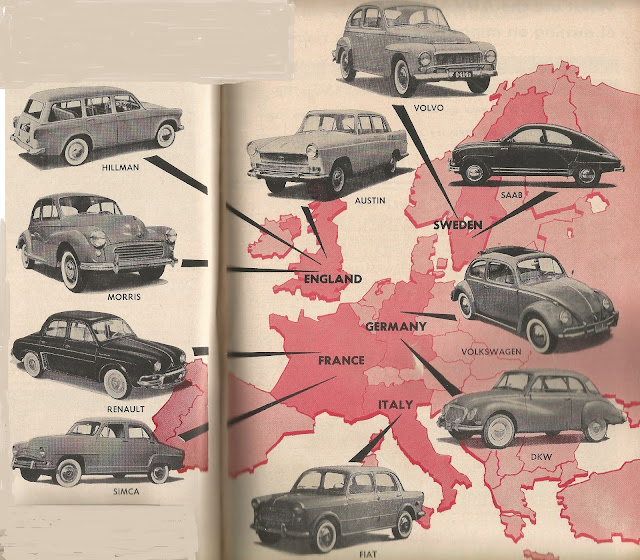
1959 Should you buy a foreign car?


Have you considered buying a foreign car?  If  you are typical of millions of Americans, you have probably thought about it. And you are probably trying to decide whether it would be a wise choice.

At present about 10 percent of all the new cars sold are imported. Not very long ago, it was generally believed that imported cars would never go over 5 percent of the total sales.

What has caused this spectacular jump in sales? Is it a fad? Are the people who own imported cars happy with them?  

The imported economy car attracts a larger percentage of professional and highly trained people than domestic cars, but this may be due more to an interest in unusual engineering design than to snobbishness or any status-making reason.

This is a portion of the article that appeared in the August 1959 edition of Popular Mechanics magazine.

Monday, May 4, 2020

1959 Versitile Back Yard Play & Lounge

No ordinary teeter-totter gives such thrills - and it won't roll over

A Back Yard "Piped" for Fun
Here's a Prescription for back yard fun at low cost:  Take two 12-foot lengths of one-inch pipe: bend to semicircles 7 feet in diameter. Make crossbars of 1 1/4 inch pipe that can be moved anywhere along the semicircles and held in place with setscrew locks.  Handy, but not essential, are two wheels from an old lawn mower attached to one end of the joined pipes.  Dwight Kindschy of Moscow, Idaho, has a moveable hammock in mind when he built the original model.  His youngsters quickly took over the hammock as a fascinating piece of gymnastic equipment.  He built another for adults - but seldom gets near it.


With a crossbar seat under the canvas, it becomes a reclining seat. 


 What better way to spend a summer afternoon?  Movable bars held by setscrew locks make for variety


Dad's original idea was for a restful hammock - but whoops, you can raise the back and make a delightful slide all the way down the canvas strip


This article appeared in the June 1959 edition of Popular Mechanics

Tuesday, April 28, 2020

1958 Hybrid Car Body

Hybrid Car Body
Attracting a lot of attention around Wethersfield, England, is a "custom" car body synthesized by a U.S. Air Force officer. Beginning with a Ford Anglia chassis, Lt. Col. Edward Risher added a cut-down Chevrolet hood, the rear windshield from an American Ford and Austin Bantom wheels.  As a final touch, Col. Risher used two wing tanks from a T-33 jet trainer.


From December 1958 Popular Mechanics magazine

Sunday, April 26, 2020

1958 Greatest Magicians

 Milbourne Christopher, shown here levitating a beautiful assistant with the greatest of ease, is acclaimed by magicians themselves to be the foremost historian of magic.  His immense reference library covers 5000 years of hocus-pocus, and his Manhattan apartment is the largest museum of magic in existence.  In addition, Chrisopher is one of the greatest of contemporary wizards and is past president of the Society of American Magicians.


 Suspicious London bobby was the first spectator to see David Devant's startling illusion, "The Mascot Moth"


 Bearded DeKolta made his wife disappear in view of audience.  Newspapers proved no trap doors were used.


"Onaip" was a staggering illusion in which a piano and pianist revolved in midair during musical number


Horace Goldin was a master at sawing an assistant in half, one of the most famous and spectacular of all stage illusions  All other magicians placed the girl in a closed box, but Goldin simply had her lie on a plank throughout his surgical sorcery.


This appeared in the December 1958 issue of Popular Mechanics magazine

Wednesday, April 22, 2020

1959 Mini Bus

Dubbed the "Little Hound Line", this scale-model bus is 3' 5" wide and 4' 4" high

Miniature Bus For Small Riders
in March 1959 Popular Mechanics magazine


Eight children and one adult, the driver, can ride in a miniature bus constructed by L.A. Beretta of Lexington, Mo., from sheet aluminum and parts of cars and arm machinery.  The tiny bus, a scale model of the type used by one of the cross-country buslines, has a top speed of 25 miles per hour.  It's powered by an eight-horsepower engine and has an automatic transmission that works through a centrifugal clutch. 


The midget bus has a wheelbase of 83 inches and weighs 1280 pounds.  Beretta spent three years of his pare time on the project, plus $475 for materials.  He did all the work himself except for welding the frame.  The springs came from a hay baler and from a mower.  The bus has tractor headlights, fender parking lights from a 1941 Ford and directional lights converted from the parking lights of a 1941 Chevrolet.  License-plate holders serve as side windows.


Sunday, March 29, 2020

American history of discouraging SOCIALISM


We have a long history of fighting socialism and choosing individual freedom.  The above advertisement is from 1958.


And here we have one from 1956


And yet another from 1950


Individual freedom over socialism.  Still a valid message we should continue to spread.
Education is the key.
History can teach if they will only listen and learn.


Saturday, March 21, 2020

1950 A Day In The Life Of Mary Martin

Article in the June 1950 edition of THE AMERICAN MAGAZINE

The most exciting cue-line in a day in the life of Mary Martin, star of the record-breaking Broadway musical show, South Pacific, is a little 6-word speech she and her husband, Richard Halliday, hear almost every night as they tiptoe up the stairs after driving 45 miles out from the theater in New York to their home in the Connecticut hills overlooking Long Island Sound.  It comes from a little canopied bed and it goes like this: "Is that you, Mommy and Daddy?"  On cue, they gallop in to say good night to their 8-year-old daughter Heller.


Mommy sleeps until noon, and is one of the few healthy persons in this world fully entitled to breakfast in bed.  In over a year Mary Martin has not missed a performance of South Pacific.  She is able to keep her healthy, she says, because her manager-husband "does everything - I don't do a thing but have fun."  After breakfast, she goes over her mail, which averages from 75 to 100 letters per day, answering all personal letters herself, while Dick takes care of business matters.  On good days, Mary and Heller take a walk on the 6-acre lawn with their 3 miniature French poodles, then Mary helps Heller with her ballet steps.  


Once a week Mary takes a voice lesson from Mrs. Helen F. Cahoon, who comes from Mary's home town, Weatherford, Texas, and has been giving her lessons since Mary was 12 years old.  Mary does her own nails and toes, but it's her hair that really gets her attention.  She washes it once at home before the show to bring out the curls, once during the show for the famous song, "I'm Gonna Wash That Man Right Outa My Hair," and once after the show to get the soap out.


At 5:45 P.M. on the dot dinner is served, and at 6:15 there's a frenzied farewell at the door to Heller and the dogs, and the hour and 15 minute drive into town.  Then comes the show, in which Mary sings 6 numbers and is off stage only about 20 minutes during the 2 1/2 hour performance.  After the curtain, she greets admirers in her dressing-room.  Finally, comes a postmidnight snack, and the drive home to Heller.                  -Wayne Amos-


Tuesday, March 3, 2020

1951 Interesting People: Mrs. Marjorie Winter


From AMERICAN MAGAZINE
August 1951
"Interesting People" section
Page 59

How's your golf game these days?  Having trouble with that slice or hook?  Well, maybe what you need is a dash of color, and Mrs. Marjorie Winter, of Dallas, Texas, is in the business of brightening up your game by manufacturing colored clubs.  She makes woods in shades of red, orange, green, purple, or yellow.  

She took over the club-making business three years ago, when her husband died.  At the time, Mrs. Winter hardly knew a putter from a brassie, but she decided to learn. First thing she found out was that many customers hesitated to buy their clubs from her because she was a woman.  Se realized she needed something to attract attention, and finally hit on the colored woods.  Soon golf pros in many parts of the country were carrying her multicolored clubs in their bags, and then the orders began coming in.  Mrs. Winter is now one of the largest makers of custom-made clubs.

Prior to her husband's death Mrs. Winter had been a housewife, but now she devotes all her time to the business.  She and her staff serve as golf diagnosticians and try to work with each customer on what's wrong with his game.  If you have trouble with your slice, they will slant your club to help you overcome your fault.  Mrs. Winter is shown here with Ben Banks, golf pro at Dallas' Cedar Crest course, who is using her clubs.


Sunday, March 1, 2020

1950s Winston-Salem, North Carolina Businesses

If you live in the Winston-Salem, NC or surrounding area, I'm sure you remember some of these places.

Some are still around!

Enjoy the stroll down memory lane...


Friday, February 28, 2020

1951 WINSTON-SALEM NC High School Yearbook Gray, Reynolds, & Hanes

This yearbook is full of so much fun, it's hard to pick just a few pictures to share.

It's hard to believe that in just one generation (I guess in some families, it could be 2 or 3 generations) things have changed so much!

I do love the majorettes and their costumes.  I still enjoy twirling the baton and wish I could do it better.

Maybe you know someone in one of these pictures?  Aunt, uncle, mom, dad, or grandma?

I wish I had more time to scan more pictures, but I must get ready for work. Only so many hours in a morning.